
THREDUP'S WHATNOT LAUNCH:LIVE SHOPPING, FAST AUCTIONS AND $1 STARTS

The first of several fashion resale news items that caught my attention yesterday morning was a press release reporting that ThredUp was launching live shows on Whatnot, starting that afternoon. Expanding into live shopping makes sense given the format's growth, and Whatnot cites fashion as one of its largest categories. Still, ThredUp built its business on a traditional, web based consignment model. Having inventory on Whatnot with $1 opening bid auctions is an entirely different approach, so I planned to tune in to see how they would handle it.
Where is the Inventory Sourced?
Before the show began, I wondered where the items for the live shows would be sourced. With the exception of its newer Direct Listing beta option, ThredUp operates on consignment. Items are accepted, processed, and displayed on the site at specific prices where consignors and buyers can view them. It seemed hard to imagine consignors agreeing to let their pieces go up for auction starting at $1.
A plausible conclusion is that this inventory belongs to ThredUp outright, pulled from items that either expired or did not meet ThredUp's intake requirements. When an item reaches the end of its listing window on the site, consignors have seven days to reclaim it for a $5.99 fee. If they pass, the item legally becomes ThredUp's property.
A review of ThredUp’s published policies provides interesting context.
Acceptance rates: ThredUp notes that an average of 60–80% of items sent in Standard Clean Out Bags and 80–90% in Premium Clean Out Bags are accepted. In its FAQ, the company states: "We don't accept items without size tags (exceptions for luxury brands and Lululemon)." Yet during the live show, there were items shown that did not have a size tag.
No-Payout brands: ThredUp maintains an easy-to-read list of brands ineligible for payouts, explaining: "Some brands with very low resale value are ineligible for a payout. We still list them to try and give them a second life." Interestingly, the schedule on Whatnot shows that the September 30th live show will include Aerie, a brand on the No-Payout Brands list. That raises an obvious question: if an item is accepted for zero payout and then auctioned off on Whatnot, ThredUp is generating revenue from inventory acquired at no upfront inventory cost.
Unsold listings: About 38% of accepted items do not sell within their consignment window.
Condition and tags: Items not accepted for the main platform because of specific flaws or missing tags appear to have found an outlet on Whatnot.

A Two Hour Live Show
I planned to tune in to this premiere show for about 15 minutes. However, I ended up watching the full two hours. The auction format moved at a brisk pace. The show took place inside a distribution center near Atlanta, which the host noted is one of ThredUp's four distribution centers in the country. The setting, showing an endless amount of clothes well organized on racks alongside a moving conveyor belt added a lively, authentic feel. Some viewers in the chat even asked if the background was actually real!
The Show was Remarkably Smooth
The host and producer: The host, Kate, was energetic, personable, and did a wonderful job keeping up with a chat running between 300 and 500+ people. She actively asked what items and sizes viewers wanted to see, and the producer was also right there in the chat answering questions and keeping the room engaged. Together, they kept the atmosphere welcoming and fun.
Shipping: The only real glitch was an early issue with the promotional flat $5.99 show shipping charge, which was sorted out. Typical ThredUp shipping is $8.99 for bundled orders and $10.99 for standard.
The Merchandise: Selling 113 items in 120 minutes is quite an accomplishment. In the beginning, when I saw items were moving quickly, I asked how long each item was available for bidding and was told 15 to 20 seconds.
ThredUp brought a strong assortment of in demand brands. In alphabetical order, they included Abercrombie & Fitch, Ann Taylor, Ann Taylor Loft, Anthropologie, Aritzia, Boden, Free People, Hollister, J.Crew, Lululemon, Maeve by Anthropologie, Reformation, and Zara.
There was a good range of sizes, and when people requested specific sizes, Kate made a point to pull them. Styles included sweaters, dresses, and tops, among others. What particularly stuck out were Lululemon leggings, I believe about 20 pairs sold, though brands like Anthropologie also had a good showing throughout the auctions.

A Few Notable Observations
Final prices: I did not track every closing price, but the majority were under $20, with many under $15, and quite a few below $10. The top sale I caught was a Reformation dress in good condition that closed at $43. At the absolute floor, a Hollister pullover hoodie in good condition opened at a dollar and closed at a dollar, making it a $1 start auction that never quite made it past the starting line.
Condition categories: According to an update on ThredUp's site, the condition grades sold on its main platform are "Excellent," "Very Good," and "Good." Nothing is stated about "Fair." Yet on Whatnot, a number of items were explicitly categorized as fair. Returning to the sourcing question, it looks like pieces that did not meet the main platform's intake standards made their way into the Whatnot inventory. A February 26, 2025 update notes that items in the Clean Out Bags should have "no rips, tears, pilling, fading, shrinkage, or blemishes of any kind." However, the Whatnot show featured pieces with "pilling throughout" in the written description, some noted discoloration or fading, and interior or exterior stains.
Listen Carefully, but Verify
Auctions with $1 starts are not where you look for pristine, flawless pieces. But with the auction clock running barely fifteen to twenty seconds, paying close attention to the details is essential. What was said on camera did not always align with the written listing:
A pair of Lululemon leggings was described by the host as "beautiful," yet the written listing stated they were in fair condition. It is certainly possible for a garment to be beautiful while still carrying noticeable flaws. But it would have been helpful if the verbal description and the condition grade were speaking the same language.
Discussing the price of a Boden dress, the host mentioned it "typically goes for $199." The listing did show an estimated retail of $199, but the dress was listed in fair condition with an exterior stain noted. A shopper would not pay retail for a stained garment, so anchoring a flawed item to its estimated retail price requires some healthy buyer skepticism.
The host was very accommodating and offered to show measurements when asked. That said, given the speed of the auction, garment measurements, fabrication, and care details were generally not announced unless requested, so opening the product listing was the safest way to verify.
Consider this Anthropologie turtleneck sweater
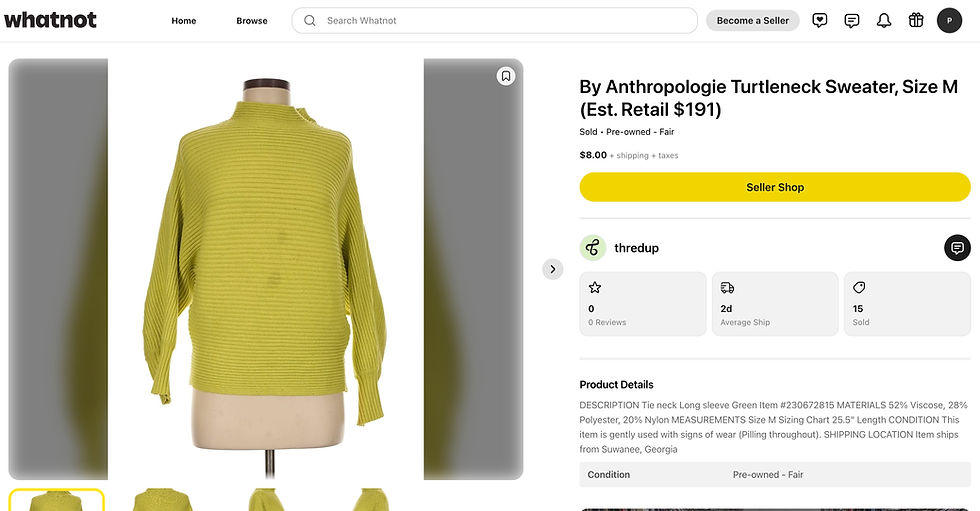
The listing carried an estimated retail of $191. On screen, two distinct stains were visible on the front. Curiously, those stains were not mentioned in the written description (which only noted "pilling throughout" which is not an accepted flaw for consignment). Kate did point out the spots on camera and suggested a Tide pen might lift them. It was a bit of a head scratcher to see it listed, but it sold for $8, so someone was happy to take on the project.
Behind the Screen: What’s Next?
The premiere show drew an engaged audience, with encouraging comments like "This is awesome" and "Love you" coming through the chat. At the same time, some viewers in the chat noticed the obvious, questioning the inventory source and pointing out that these looked like rejected or unsold website / app items that ThredUp acquired for free. The team did not address those comments, focusing instead on gathering requests for future shows. Beyond moving merchandise, the broadcast was clearly instructive for ThredUp. By interacting directly with hundreds of viewers in real time, the host and producer gathered immediate feedback on the auction pace that kept shoppers watching, the specific brands and sizes that sparked bidding, and the other product categories the audience wants to see featured, such as dedicated handbag shows.
ThredUp has already scheduled more auctions, including an activewear sale featuring Lululemon, Athleta, Gymshark, Vuori, and Aerie, on September 30th followed by a Handbags & Accessories how on October 1, 2026. For a platform that built its reputation on website / app browsing and automated processing, selling live is a different way to connect with shoppers. Whether this turns into a permanent channel or simply serves as a fast-track tool to clear distribution center racks, it will be fascinating to watch how the format evolves.
Full disclosure: This post reflects my personal opinions and observations and is intended for informational purposes only. It should not be considered professional, financial, or legal advice. Because this was a fast paced live show with items moving at fifteen second intervals, observations are based on what was visible and stated in real time, and unintentional oversights are always possible. This post does not cover all selling and buying rules for each platform mentioned. Please check the ThredUp and Whatnot sites for complete, official policies. I have sold with ThredUp through both the consignment model and Direct Listing, and all of my transactions have been satisfactory. I have no professional relationship with ThredUp or Whatnot and was not compensated to write this post. With the exception of the screenshot of the Anthropologie turtleneck sweater, the accompanying images were created using Gemini AI Pro.



Comments